
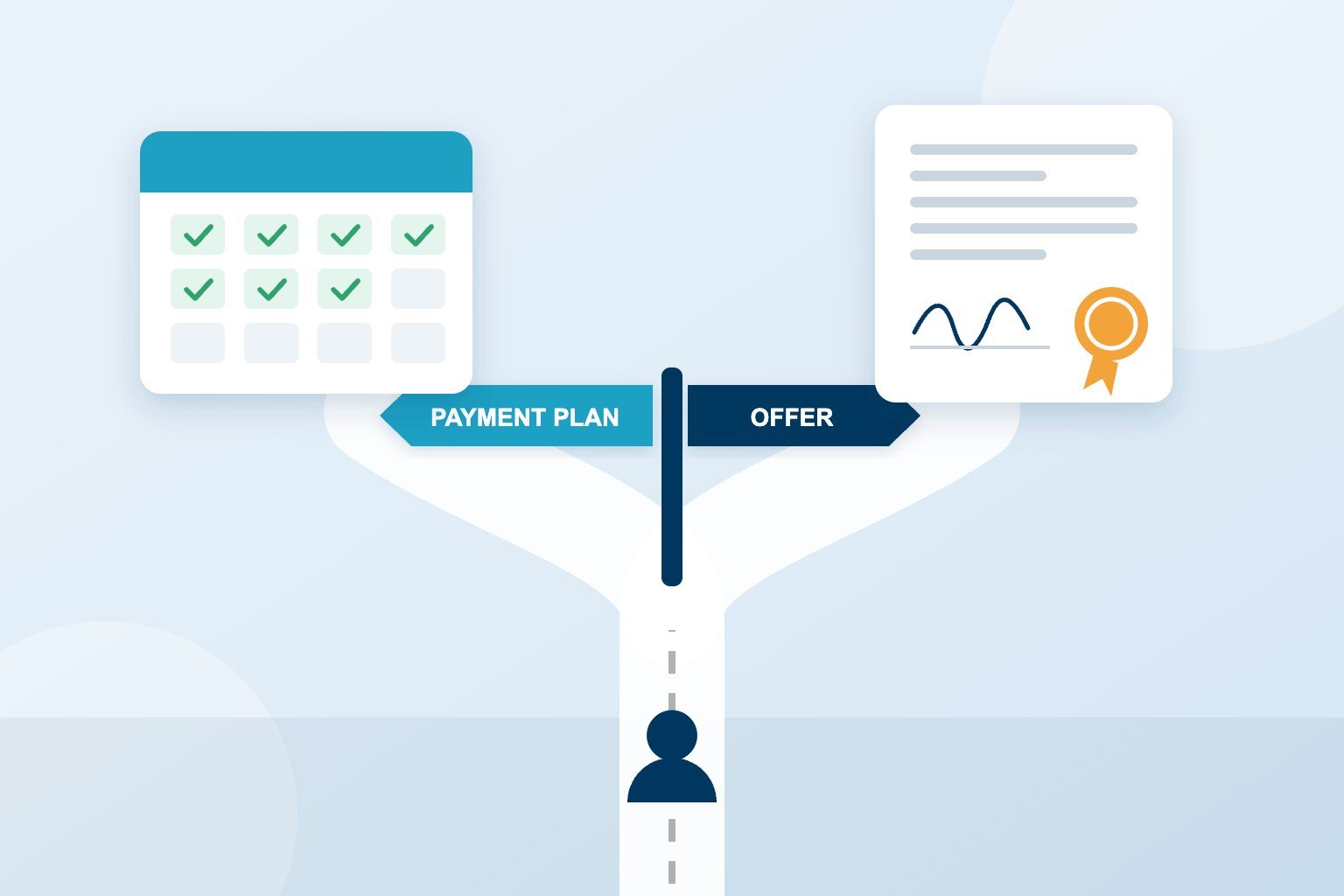
Short answer: An IRS payment plan lets you pay your full balance over time, while an Offer in Compromise may allow you to settle your tax debt for less than the full amount you owe. The IRS generally won’t accept an offer if you can pay in full through a payment plan or the equity in your assets, so a payment plan fits most people who can afford monthly payments, and an offer is for those who truly can’t.
Choosing the wrong option can waste months and leave penalties and interest growing. Here is how the two compare and how to think about which one fits your situation.
What Is an IRS Payment Plan?
A payment plan, also called an installment agreement, is an agreement to pay what you owe over time. The IRS offers short-term plans for balances you can pay in 180 days or less and long-term plans with monthly payments. Individuals who owe $50,000 or less in combined tax, penalties and interest and have filed all required returns can generally apply online, according to the IRS payment plans page.
Keep in mind that interest and some penalty charges continue to be added until the balance is paid in full. For individuals who filed on time, the failure-to-pay penalty rate is reduced while an approved installment agreement is in effect. Learn more about our installment agreement services.
What Is an Offer in Compromise?
The IRS explains that an Offer in Compromise may allow you to settle your tax debt for less than the full amount you owe. When reviewing an offer, the IRS considers your income, expenses and asset equity. To be eligible, you generally must:
- File all required tax returns
- Make required estimated tax payments
- Not be in an open bankruptcy proceeding
- For employers, make required federal tax deposits for the current quarter and the two preceding quarters
The IRS describes two ways to pay an offer. With a lump-sum offer, you pay 20% of the offer amount when you apply and, if it is accepted, pay the rest in five or fewer payments. With a periodic payment offer, you make an initial payment when you apply and keep making periodic payments while the IRS considers your offer. Individuals who meet the IRS’s low-income qualifications may not have to make those payments during the review.
The IRS offers a Pre-Qualifier tool to help you check eligibility, but using it does not guarantee acceptance. You can read more about how we approach this option on our Offer in Compromise page.
Payment Plan vs. Offer in Compromise: Key Differences
- Amount paid: A payment plan pays the full balance over time. An accepted offer resolves the debt for an agreed amount based on what the IRS determines you can pay.
- Who it fits: Payment plans fit people who can afford monthly payments. Offers are generally for people who can’t pay in full through a payment plan or asset equity.
- Paperwork: Many payment plans can be set up online. An offer requires detailed financial disclosure and IRS review.
- Collection activity: While an offer is being considered, the IRS says it suspends most collection activities, though it may file a Notice of Federal Tax Lien.
- Collection period: The IRS extends the collection period while it considers an offer. The collection period is not suspended while an installment agreement is in effect.
- Liens: The IRS won’t release federal tax liens until an accepted offer is paid in full.
How the IRS Decides on an Offer
The IRS reviews your income, expenses and asset equity to judge what you can afford. If the numbers show you can pay the balance in full through a payment plan or by using equity in your assets, an offer is generally not accepted. That is why an honest review of your finances before applying is so important.
If neither option fits because you can’t afford any payment right now, Currently Not Collectible status may be worth reviewing. Time also matters, since the IRS generally has a limited period to collect, as we explain in How Long Can the IRS Collect Back Taxes?.
Which Option Is Right for You?
A payment plan may fit if:
- Your income covers your living expenses with room for a monthly payment
- You want a simpler, faster process
- You can pay the full balance before the collection period ends
An Offer in Compromise may be worth exploring if:
- Your income and assets are not enough to pay the balance in full over time
- You have filed all required returns and are current with estimated payments or deposits
- You are prepared to provide full financial documentation
What to Do Next
- Make sure all required tax returns are filed.
- Total your monthly income and necessary living expenses.
- List your assets and any equity in them.
- Compare what you can realistically pay each month with your total balance.
- Get a professional review before applying, so you choose the option that best fits your finances.
Frequently Asked Questions
Is an Offer in Compromise better than a payment plan?
Not necessarily. An offer only fits if you can’t pay in full through a payment plan or asset equity. For many taxpayers, a payment plan is the more realistic path.
Do penalties and interest stop on a payment plan?
No. The IRS says interest and some penalty charges continue to be added until the balance is paid in full, although the failure-to-pay penalty rate is reduced for individuals who filed on time and have an approved installment agreement.
Does the IRS stop collection while an offer is pending?
The IRS says it suspends most collection activities while it considers an offer. It may still file a Notice of Federal Tax Lien, and the collection period is extended during the review.
Can I apply for an Offer in Compromise if I haven’t filed all my returns?
Generally, no. The IRS requires that you file all required tax returns and make required estimated tax payments before it will consider an offer.
Get a Clear Recommendation
Deciding between a payment plan and an Offer in Compromise starts with an accurate look at your finances. Tax Relief Systems’ Enrolled Agents have helped more than 5,780 clients since 2009, and we work with taxpayers in all 50 states. If you owe $10,000 or more, schedule your free, confidential consultation to find out which option fits your situation.