
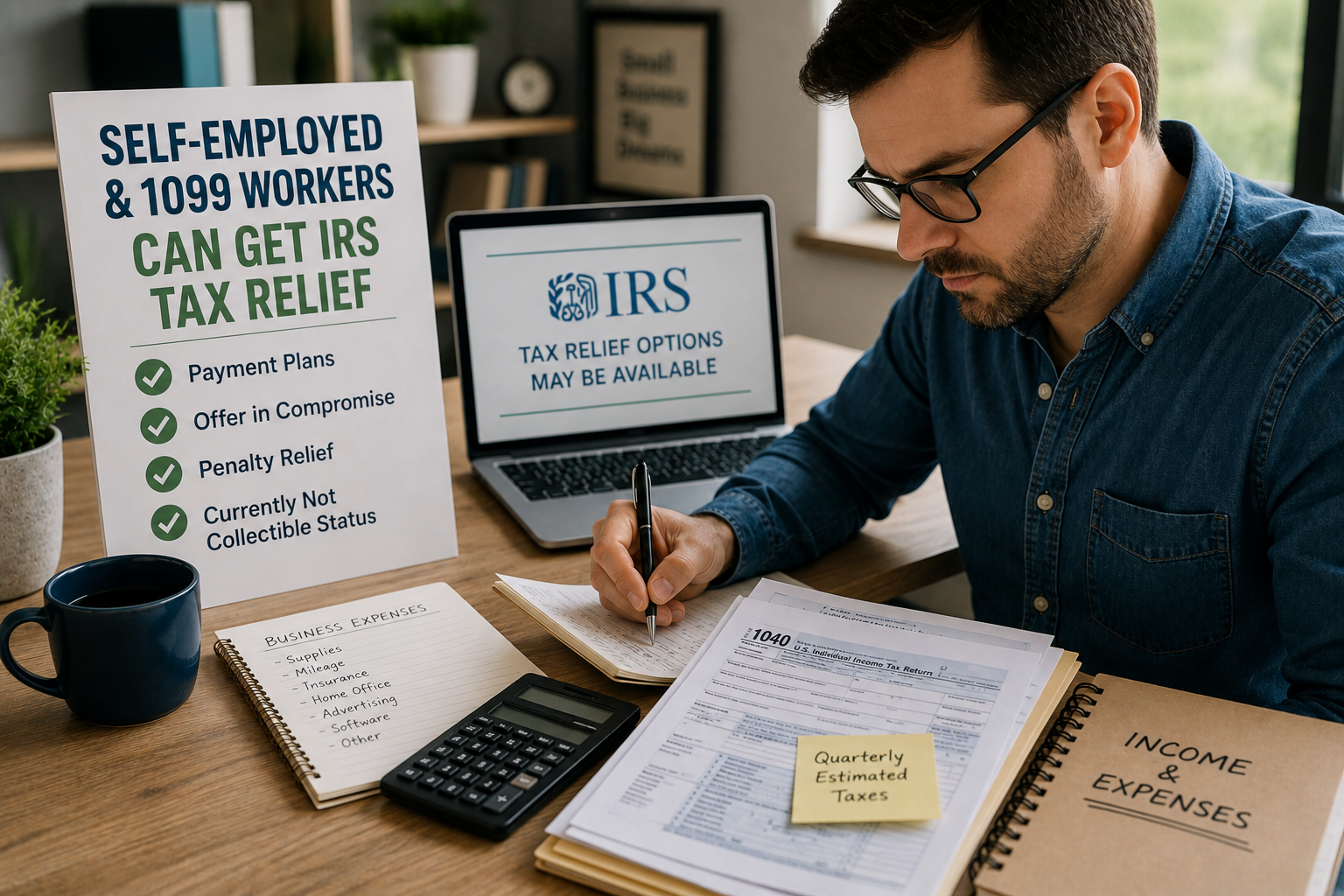
Many self-employed individuals and independent contractors find themselves facing unexpected tax debt. Unlike traditional employees, taxes are not automatically withheld from payments received as a freelancer, consultant, gig worker, or business owner.
The good news is that being self-employed does not prevent you from qualifying for IRS tax relief programs.
Why Do Self-Employed Taxpayers Often Owe the IRS?
When you work as an employee, your employer typically withholds federal taxes from each paycheck.
Self-employed individuals are responsible for making estimated tax payments throughout the year. If those payments are missed or underestimated, a tax balance can grow quickly.
Common reasons self-employed taxpayers owe the IRS include:
• Failure to make quarterly estimated tax payments
• Unexpected increases in income
• Poor record keeping
• Business losses or cash flow problems
• Self-employment tax obligations
Can Self-Employed Taxpayers Qualify for Tax Relief?
Yes.
The IRS offers the same relief programs to self-employed taxpayers that are available to other individuals.
Depending on your circumstances, you may qualify for:
• Installment Agreements
• Offer in Compromise
• Penalty Abatement
• Currently Not Collectible status
The best option depends on your income, expenses, assets, and overall financial condition.
What Is an Offer in Compromise?
An Offer in Compromise allows qualified taxpayers to settle their tax debt for less than the full amount owed.
The IRS considers factors such as:
• Income
• Necessary living expenses
• Available assets
• Future ability to pay
Not everyone qualifies, but it can be a valuable solution for taxpayers facing significant hardship.
Can Penalties Be Reduced?
In many situations, IRS penalties may be reduced or removed.
Taxpayers who have a history of compliance or who experienced circumstances beyond their control may qualify for penalty relief.
Reducing penalties can lower the total amount owed and make resolving the debt more manageable.
What If I Cannot Afford Any Payments?
If paying the IRS would prevent you from covering necessary living expenses, you may qualify for Currently Not Collectible status.
This can temporarily stop collection actions while your financial situation is evaluated.
Why Professional Guidance Matters
Self-employed taxpayers often have more complex financial situations than traditional employees.
Business income, expenses, assets, and cash flow can significantly affect which tax relief programs are available.
A tax relief professional can review your situation, identify the most appropriate options, and communicate directly with the IRS on your behalf.
How Quarterly Estimated Tax Payments Work
Self-employed taxpayers generally pay tax four times a year using estimated payments. For most people, the due dates are April 15, June 15, September 15 and January 15 of the following year (moved to the next business day when they fall on a weekend or holiday).
Estimated payments need to cover both income tax and self-employment tax. Self-employment tax is 15.3% of net earnings: 12.4% for Social Security, up to the annual wage base, and 2.9% for Medicare. That second tax is what surprises many new freelancers and gig workers.
Common Mistakes That Lead to IRS Debt
- Not setting aside a percentage of every payment for taxes
- Mixing personal and business money, which makes deductions hard to prove
- Not filing because you can’t pay. The failure-to-file penalty is generally 5% of the unpaid tax per month, up to 25%, which is much steeper than the failure-to-pay penalty of 0.5% per month. Filing on time, even without payment, limits the damage.
- Ignoring IRS notices until a levy arrives
Steps to Get Back on Track
- File every required return. The IRS generally requires you to be current on filing before it will approve a payment plan or settlement. If you are behind, see what happens if you have unfiled tax returns.
- Start making current-year estimated payments. Staying current going forward is usually a condition of any resolution.
- Choose a resolution for the old balance. Options include an installment agreement, an Offer in Compromise, penalty abatement or Currently Not Collectible status.
- Separate your business finances. A dedicated account and good records make future tax time much easier.
Frequently Asked Questions
Can 1099 workers set up a payment plan with the IRS?
Yes. Self-employed taxpayers can qualify for the same IRS installment agreements as employees, as long as required returns are filed.
Can the IRS take payments my clients owe me?
Yes. For self-employed taxpayers, the IRS can levy accounts receivable, meaning it can instruct clients or platforms to send payments owed to you directly to the IRS. This is one reason to resolve a balance before enforcement begins.
I drive for rideshare or work gigs in Las Vegas. Can you help?
Yes. Gig and hospitality workers are a large part of our Las Vegas tax relief clients, and we help self-employed taxpayers nationwide.
Get Help From Tax Relief Systems
If you are self-employed, receive 1099 income, or operate your own business and owe taxes to the IRS, help may be available.
If you have questions about tax relief options for self-employed individuals or owe more than $10,000 to the IRS, we can help you understand your options and work toward a resolution.
Tax Relief Systems LLC
Phone: (877) 807-3133
Schedule a consultation:
https://taxreliefsystemsllc.com/schedule-a-consultation/
Email:
info@taxreliefsystemsllc.com